Projection: You Are My Mirror and I Am Yours

Projection: You Are My Mirror and I Am Yours

(I wrote the following post for the Jung Society of Utah blog.)

“Projections change the world into the replica of one’s own unknown face.”
– C.G. Jung

Projections are images we have of others, which are generated by the psyche and based in our own fears, desires, impulses, and unresolved issues, most of which are unconscious. Jung wrote, “We must bear in mind that we do not make projections, rather they happen to us.” Projection happens when we are “certain we know what other people think or what their true character is,” and interact with with them based on those assumptions.

We see others not as they are, but as we are 

While the most obvious example of projection is seeing our own shadow traits in others, this can also be true of those traits we view as desirable, since the ego projects anything it is unable to identify with. An example of this could be someone who is jealous of a friend’s beauty or intelligence, but is unable to recognize those traits in him- or herself.

Projection is the cause of many misunderstandings in relationships.
Photo by Kampus Production on Pexels.com

Additionally, when we feel certain we know what others think or what they’re really like, this may cause us to judge them or ourselves unfairly. It is likely that many of our insecurities are based in our own misguided perceptions of others, as well as our worries over how we believe they see us. Consider the things we keep to ourselves, the lies we tell, and the masks we wear in order to impress others or protect ourselves from them, based on whatever images we have projected onto them.

As an example of this, I recently had dinner with a friend, and an opportunity came up in the conversation to tell him what he truly means to me. But instead of honestly sharing my feelings, I froze and said something else because I felt worried about how he would respond—certain that it would be some form of rejection.

Withdrawing projections 

The antidote to projection is authenticity, which I have heard referred to as “the highest form of spirituality.” When we are authentic, we are willing to risk being seen as we truly are, shadow and all, and we also become more able to see others as they truly are. In my experience, the willingness to take that risk is based in love, both for oneself and others, which creates a relationship that allows for reflection. Jung said:

“Now “Love thy neighbor as thyself” is really a very profound formula … You can never get to yourself without loving your neighbor—that is indispensable … You would have no means of comparison … So whoever insists upon loving his neighbor cannot do it without loving himself to a certain extent.”

With the self-knowledge and greater wholeness that is created through this love, we may begin to withdraw our projections. According to Jung, “The best political, social, and spiritual work we can do is to withdraw the projection of our own shadow onto others.”

“As you live Deeper in the Heart, the Mirror gets clearer and cleaner.”
– Rumi
(Photo by Mariana Kurnyk on Pexels.com)

Embodiment: The Body as a Gateway to Presence

Embodiment: The Body as a Gateway to Presence

(It was a joy to interview Erin Geesaman Rabke and Carl Rabke for the following post, which originally appeared on the Jung Society of Utah blog. I also thoroughly enjoyed their presentation about “The Wisdom in the Wilderness of Your Body.”)

Erin Geesaman Rabke and Carl Rabke met in their early 20s when they both worked at the Oasis Cafe. In their first conversation they discovered that they had both been walking very similar paths—including practicing in the Tibetan Buddhist tradition and studying Tai Chi and Yoga. After a few years of being close friends, they got together as a couple. Their love of embodied practices has been a shared passion all throughout their 20 year connection. They answer some questions below about embodiment and why it matters.

What is embodiment?

Embodiment invites a different relationship with our bodies—a rich one, indeed, where the body is no longer regarded as an object, but an intimate, living process. The body offers us a gateway to presence, as long as we’re alive.

Embodiment includes awareness of sensation, feelings, thoughts, and environment in a not-purely-mental way. Being embodied doesn’t preclude conceptual thought, but offers a grounded infrastructure through which we can have a different relationship with our thoughts. Embodiment is mindfulness not as a mental practice, but as a lived experience. “I’m here. I’m resonating with what is, and I’m aware of it.”

In our work, we learn to more fully inhabit our bodies with non-judgmental awareness. We learn to reclaim a way of sensing our selves that we knew as children. We learn to trust the organic intelligence of our bodies as an expression of nature. Living in this way can lead to a life that is curious, rich, respectful, and optimistic.

aspen leaf and droplet

How embodiment relate to Jung’s ideas, especially with regard to individuation and wholeness?

There is a great story of Carl Jung meeting with the Hopi Elder, Mountain Lake in 1925. Essentially, Mountain Lake said, “You know why White people are so crazy? They think in their heads. We think here (gesturing toward his heart).” This interaction had a profound impact on Jung’s work.

In our embodiment, there is a need for differentiation and integration; another way to describe individuation and wholeness. Often, as modern western people, we lean a bit heavily in the individuation direction, holding ourselves as separate beings encapsulated by our skin. But our bodies are always in relationship with a larger whole—individuated and integrated at the same time. Our heartbeats and our breathing rates affect each other; our bones are being made in this moment through the force of gravity and the support of the earth; our breath puts us in relationship with the plant life in the exchange of oxygen and carbon dioxide.

We also tend to do this within ourselves—separating our wholeness into parts. We do this most intensely when there is some kind of pain or challenge. The sciatica, the migraines, the food allergy, the grief, the aging knees… these can seem to become solid things that we relate to. Part of our work with people is to help invite these parts back into an experience of interdependent wholeness. Not only is the back pain in relationship to what your ribs and jaw are doing, but also connected to what is happening in your marriage, your work, your relationship to your dreams for your life.

cmzc buddha hand

How has working together as a team been beneficial for you and those you teach?

When we teach together, it can be really valuable to have two voices and we often love to riff off of each other, even as we joke that we “share a brain” because we often think so alike about this work. We also find there is something beneficial in having the masculine and feminine presence teaching together. We adore each other and the work deeply, and we truly live this work in our relationship. Many people have said they’ve found it helpful and inspiring to see our relationship as a part of our teaching.

What can Jung Society guests expect from your presentation?

Well, what they should not expect is a lecture where we are in our heads talking and sharing information, and they sit in their chairs listening from their heads. We plan to share our understandings of principles in this work not just mentally, but to invite the guests into embodied experience. We plan on exploring together the question of “What is embodiment?” and “Why does this perhaps matter in your life?” We plan on keeping the gathering as experiential as possible, as opposed to simply sharing ideas. We hope to have a lot of fun.

Please join the Jung Society of Utah for this soulful evening!

Date: May 5th
Time: 7-9pm
Location: Downtown Library
210 East 400 South
Salt Lake City
Cost: Free, please become a member

Robert Waggoner on the Transformative Potential of Lucid Dreaming

Robert Waggoner on the Transformative Potential of Lucid Dreaming

(I had the good fortune to interview Robert Waggoner about the lucid dreaming for the Jung Society of Utah blog. He has a rare gift for lucid dreaming, is a talented speaker, and is also a truly kind person.)

Author and dream expert Robert Waggoner will share his insights about lucid dreaming at the Jung Society of Utah’s spectacular season opener the weekend of October 2, 2015. He answers some questions about lucid dreaming and its extraordinary potential for advancing personal and spiritual growth in the interview below.

Robert Waggoner, Dream Expert.

When did you first discover lucid dreaming?

In high school, I read in Carlos Castaneda’s Journey to Ixtlan that one can become consciously aware in a dream by finding one’s hands. I decided to try it, and, within three nights, I managed to induce my first lucid dream. It was a long, deep, and profound experience.

In what ways have you used lucid dreaming to help you live a more meaningful life?

When you are consciously aware in a lucid dream and look back at your waking life, you see it in a new way – much like the lunar astronauts looked back at the blue ball of Earth hanging in the vastness of space. The experience changes your perspective. If you take it far enough, you can discover a new depth and dimension to waking life.

Lucid dreaming gives perspective to your waking life. Image by Scientific American.

You begin to see that you can bring the ideas and insights of lucid dreaming into your waking life to achieve more ‘lucid living.’ You begin to see experience as a creation, and you learn to examine the underlying assumptions and belief patterns that prop up your version of experienced reality. If you allow it to, lucid dreaming gradually reveals your limiting beliefs and expectations, your ‘issues’ and shadow, as well as your potential, depth, and breadth.

What are some of the psychological benefits of lucid dreaming?

People have used lucid dreaming to overcome PTSD, major and minor fears/phobias, generalized anxiety, obsessive habits, and more. Lucid dreaming truly seems a revolutionary psychological tool.

Lucid dreaming is an amazing psychological tool to help people. Photo by Klontak.

What can Jung Society attendees look forward to with respect to your presentation and workshop in October?

I look forward to returning to Salt Lake City to present some of the more recent research on lucid dreaming, as well as the evolving edge of its potential. It’s an exciting time!

The first day of the workshop, I’ll explain the various induction techniques for lucid dreaming, as well as how to stabilize the lucid dream, so you can explore it more thoughtfully, or even begin to experiment and learn about the hidden structural elements and principles behind the lucid dream.

The second day, I intend to explore personal goals of the attendees, as well as discuss preferred practices for areas such as emotional or physical healing, spiritual growth, and accessing creativity. We will also discuss how to consciously engage the unseen larger awareness within the lucid dream.

When I offer workshops, I call my approach ‘heart centered’ lucid dreaming, since I encourage people to pay attention to what comes in the lucid dream and the inner intuitions there. It comes for a purpose – and it should not be ignored as one chases some ‘ideal’.

Register at the links below for this transformational weekend with Robert Waggoner.

Saturday only: Early bird discount only $79 before Sept 20th, after $99 (incl. 5 CEs)
Sunday only: Early bird discount only $79 before Sept 20th, after $99 (incl. 5 CEs)
Saturday and Sunday: Early bird discount only $150 before Sept 20th, after $185 (incl. 10 CEs)

Mandalas: Symbols of the Self

Mandalas: Symbols of the Self

(This was my very first post for the Jung Society of Utah blog. Soon after I submitted it for publication, I had the most lovely dream about meeting Jung, chatting with him, and giving him a hug.)

“I sketched every morning in a notebook a small circular drawing, a mandala, which seemed to correspond to my inner situation at the time… Only gradually did I discover what the mandala really is: … the Self, the wholeness of the personality, which if all goes well, is harmonious.”
– C.G. Jung

Carl Jung used the Sanskrit word mandala, meaning “magic circle,” to describe the circular drawings he and his patients created. While mandalas have been used throughout many ancient traditions, including Buddhism and Hinduism, Jung is credited with introducing these images to the Western world. Jung studied mandalas extensively, finding a great deal of potential symbolic meaning in them. He intimately associated them with psychological and spiritual health.

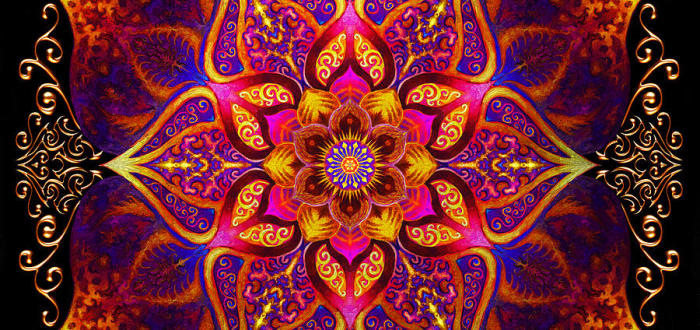
Mandalas are beautiful images that have strong symbolic meaning. Image by deviantart.com.

An Archetype of Wholeness

Jung created his first mandala in 1916, before learning about the Eastern tradition. And he used mandalas as an important component of his work with patients, as well as in his own personal development. Believing that mandalas were archetypal  forms representing the Self, or total personality, he referred to them as “archetypes of wholeness.” Jung discovered that dreaming of or creating mandalas is a natural part of the individuation process, and he encouraged his patients to create them spontaneously. When a mandala image appeared in a patient’s artwork or dreams, he found it usually indicated progress toward new self-knowledge.

“The severe pattern imposed by a circular image of this kind compensates the disorder of the psychic state–namely through the construction of a central point to which everything is related,” Jung stated. He believed that the circle invites conflicting parts of our nature to appear and allows for the unification of opposites in order to represent the sum of who we are. He found this sense of wholeness was reflected in the lives of his patients, as he was able to trace the progression of an individual’s psychological recovery by correlating it with the coherence of the mandalas they drew.


Carl Jung found that patients' mandalas intuitively expressed their need for wholeness. Image courtesy of Clinical Psych Reading.
Carl Jung found that patients’ mandalas intuitively expressed their need for wholeness. Image courtesy of Clinical Psych Reading.

Jung’s patients created mandalas intuitively, and he observed that patients with no prior knowledge of mandalas repeatedly created very similar images throughout the course of their progress. This enabled him to identify emotional disorders and work towards wholeness in personality.

Some of the common symbols Jung encountered as he interpreted mandalas included circular or egg-shaped formations, flowers or wheels, circles within a square or the reverse, which Jung was particularly interested in. He frequently saw the number four or its multiples in mandalas, which was often represented by squares, crosses or suns or stars with four or eight rays. Discovering what these symbols meant to patients gave Jung insight into their personalities, challenges and more.

A Sacred Space for the Self

Jung believed that creating mandalas offered a “safe refuge of inner reconciliation and wholeness”, providing a sacred space into which we can invite the Self. He also noticed that creating mandalas had a calming, focusing effect on his patients’ psychological states. I’ve personally observed this to be true as I’ve drawn and colored my own mandalas.

When we create mandalas, we are making a personal symbol that represents who we are at the moment. Would you like to see a reflection of your Self? You can color a mandala or try drawing one of your own. Then, check out how to interpret your mandala by visiting this site!