I got the opportunity to write about a wonderful clinic that is improving healthcare access in Midvale, UT.
The Mid-Valley Health Clinic sees patients on a sliding fee scale and is accepting new patients. They are committed to providing quality healthcare in the Midvale community.
“[Addiction is] the equivalent, on a low level, of the spiritual thirst of our being for wholeness.”
– C.G. Jung
Carl Jung was highly influential in the founding of Alcoholics Anonymous (AA). Jung intuited that those suffering from addiction were actually in search of the numinous, or a spiritual experience associated with the divine. Jung shared this insight in a letter to Bill W., one of the founders of AA.
In 1926, Jung treated an American patient named Rowland H. for alcoholism. However, Rowland relapsed soon after leaving Zurich. He returned to seek Jung’s help. Jung told Rowland that neither medicine nor psychiatry had a cure for alcoholism, but explained, “Exceptions to cases such as yours have been occurring since early times. Here and there, once in a while, alcoholics have had what are called vital spiritual experiences.” Jung described such experiences as “huge emotional displacements and rearrangements. Ideas, emotions, and attitudes which were once the guiding forces of the lives of these men are suddenly cast to one side, and a completely new set of conceptions and motives begin to dominate them.” However, Jung cautioned that these experiences are “comparatively rare.”
Many years later, Jung received a letter from Bill W., explaining that Rowland had joined a religious movement called the Oxford Groups, and there he found “a conversion experience that released him for the time being from his compulsion to drink.” Rowland carried this message of inner change to his friend, Ebby T., who then carried it to Bill, who co-founded AA. In his letter to Jung, Bill wrote, “This astonishing chain of events actually started long ago in your consulting room, and it was directly founded upon your own humility and deep perception.”
“Spiritus Contra Spiritum”
Jung treated many alcoholic patients at the Burghölzli Psychiatric Hospital in Zurich (Image from Wikimedia).
In his reply to Bill W., Jung wrote, “You see, “alcohol” in Latin is “spiritus” and you use the same word for the highest religious experience as well as for the most depraving poison. The helpful formula therefore is: spiritus contra spiritum.” Jung believed it is necessary to replace the addictive substance with a transcendent experience that the individual finds more satisfying. He explained that this type of experience “can only happen to you when you walk on a path which leads you to higher understanding. You might be led to that goal by an act of grace or through a personal and honest contact with friends, or through a higher education of the mind beyond the confines of mere rationalism.”
Psychologist James Hillman phrased it more simply: “You don’t really want the alcohol. If you can find out what you really want, if you can find your true desire, then you’ve got the answer to your addiction.”
Would you like to learn more about addiction and recovery? Attend a FREE workshop at Cirque Lodge on Saturday, November 14, 2015. In this workshop, we will explore the roots of Jung’s influence and the practical application of these insights in addiction treatment today.
(I had the good fortune to interview Robert Waggoner about the lucid dreaming for the Jung Society of Utah blog. He has a rare gift for lucid dreaming, is a talented speaker, and is also a truly kind person.)
Author and dream expert Robert Waggoner will share his insights about lucid dreaming at the Jung Society of Utah’s spectacular season opener the weekend of October 2, 2015. He answers some questions about lucid dreaming and its extraordinary potential for advancing personal and spiritual growth in the interview below.
Robert Waggoner, Dream Expert.
When did you first discover lucid dreaming?
In high school, I read in Carlos Castaneda’s Journey to Ixtlan that one can become consciously aware in a dream by finding one’s hands. I decided to try it, and, within three nights, I managed to induce my first lucid dream. It was a long, deep, and profound experience.
In what ways have you used lucid dreaming to help you live a more meaningful life?
When you are consciously aware in a lucid dream and look back at your waking life, you see it in a new way – much like the lunar astronauts looked back at the blue ball of Earth hanging in the vastness of space. The experience changes your perspective. If you take it far enough, you can discover a new depth and dimension to waking life.
Lucid dreaming gives perspective to your waking life. Image by Scientific American.
You begin to see that you can bring the ideas and insights of lucid dreaming into your waking life to achieve more ‘lucid living.’ You begin to see experience as a creation, and you learn to examine the underlying assumptions and belief patterns that prop up your version of experienced reality. If you allow it to, lucid dreaming gradually reveals your limiting beliefs and expectations, your ‘issues’ and shadow, as well as your potential, depth, and breadth.
People have used lucid dreaming to overcome PTSD, major and minor fears/phobias, generalized anxiety, obsessive habits, and more. Lucid dreaming truly seems a revolutionary psychological tool.
Lucid dreaming is an amazing psychological tool to help people. Photo by Klontak.
What can Jung Society attendees look forward to with respect to your presentationand workshop in October?
I look forward to returning to Salt Lake City to present some of the more recent research on lucid dreaming, as well as the evolving edge of its potential. It’s an exciting time!
The first day of the workshop, I’ll explain the various induction techniques for lucid dreaming, as well as how to stabilize the lucid dream, so you can explore it more thoughtfully, or even begin to experiment and learn about the hidden structural elements and principles behind the lucid dream.
The second day, I intend to explore personal goals of the attendees, as well as discuss preferred practices for areas such as emotional or physical healing, spiritual growth, and accessing creativity. We will also discuss how to consciously engage the unseen larger awareness within the lucid dream.
When I offer workshops, I call my approach ‘heart centered’ lucid dreaming, since I encourage people to pay attention to what comes in the lucid dream and the inner intuitions there. It comes for a purpose – and it should not be ignored as one chases some ‘ideal’.
Register at the links below for this transformational weekend with Robert Waggoner.
(This was my very first post for the Jung Society of Utah blog. Soon after I submitted it for publication, I had the most lovely dream about meeting Jung, chatting with him, and giving him a hug.)
“I sketched every morning in a notebook a small circular drawing, a mandala, which seemed to correspond to my inner situation at the time… Only gradually did I discover what the mandala really is: … the Self, the wholeness of the personality, which if all goes well, is harmonious.”
– C.G. Jung
Carl Jung used the Sanskrit word mandala, meaning “magic circle,” to describe the circular drawings he and his patients created. While mandalas have been used throughout many ancient traditions, including Buddhism and Hinduism, Jung is credited with introducing these images to the Western world. Jung studied mandalas extensively, finding a great deal of potential symbolic meaning in them. He intimately associated them with psychological and spiritual health.
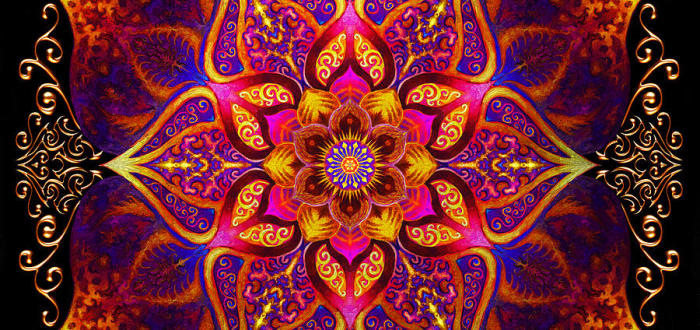
Mandalas are beautiful images that have strong symbolic meaning. Image by deviantart.com.
An Archetype of Wholeness
Jung created his first mandala in 1916, before learning about the Eastern tradition. And he used mandalas as an important component of his work with patients, as well as in his own personal development. Believing that mandalas were archetypal forms representing the Self, or total personality, he referred to them as “archetypes of wholeness.” Jung discovered that dreaming of or creating mandalas is a natural part of the individuation process, and he encouraged his patients to create them spontaneously. When a mandala image appeared in a patient’s artwork or dreams, he found it usually indicated progress toward new self-knowledge.
“The severe pattern imposed by a circular image of this kind compensates the disorder of the psychic state–namely through the construction of a central point to which everything is related,” Jung stated. He believed that the circle invites conflicting parts of our nature to appear and allows for the unification of opposites in order to represent the sum of who we are. He found this sense of wholeness was reflected in the lives of his patients, as he was able to trace the progression of an individual’s psychological recovery by correlating it with the coherence of the mandalas they drew.
Carl Jung found that patients’ mandalas intuitively expressed their need for wholeness. Image courtesy of Clinical Psych Reading.
Jung’s patients created mandalas intuitively, and he observed that patients with no prior knowledge of mandalas repeatedly created very similar images throughout the course of their progress. This enabled him to identify emotional disorders and work towards wholeness in personality.
Some of the common symbols Jung encountered as he interpreted mandalas included circular or egg-shaped formations, flowers or wheels, circles within a square or the reverse, which Jung was particularly interested in. He frequently saw the number four or its multiples in mandalas, which was often represented by squares, crosses or suns or stars with four or eight rays. Discovering what these symbols meant to patients gave Jung insight into their personalities, challenges and more.
A Sacred Space for the Self
Jung believed that creating mandalas offered a “safe refuge of inner reconciliation and wholeness”, providing a sacred space into which we can invite the Self. He also noticed that creating mandalas had a calming, focusing effect on his patients’ psychological states. I’ve personally observed this to be true as I’ve drawn and colored my own mandalas.
When we create mandalas, we are making a personal symbol that represents who we are at the moment. Would you like to see a reflection of your Self? You can color a mandala or try drawing one of your own. Then, check out how to interpret your mandala by visiting this site!
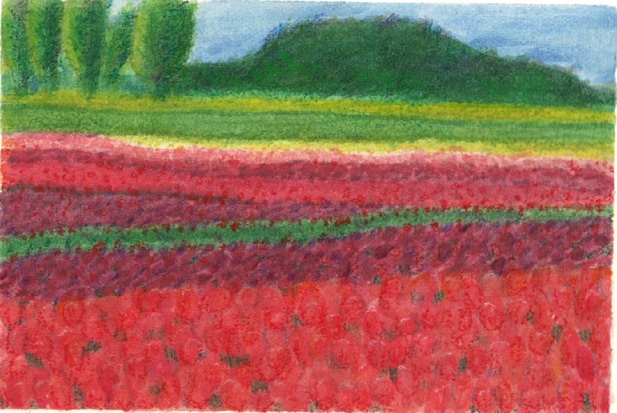
One of my coworkers sent me a nice photo he took of the tulip fields near Seattle, WA, and I decided it would be fun to paint it. I’m excited to go there next month and see them for myself.







 Alembic Publications
